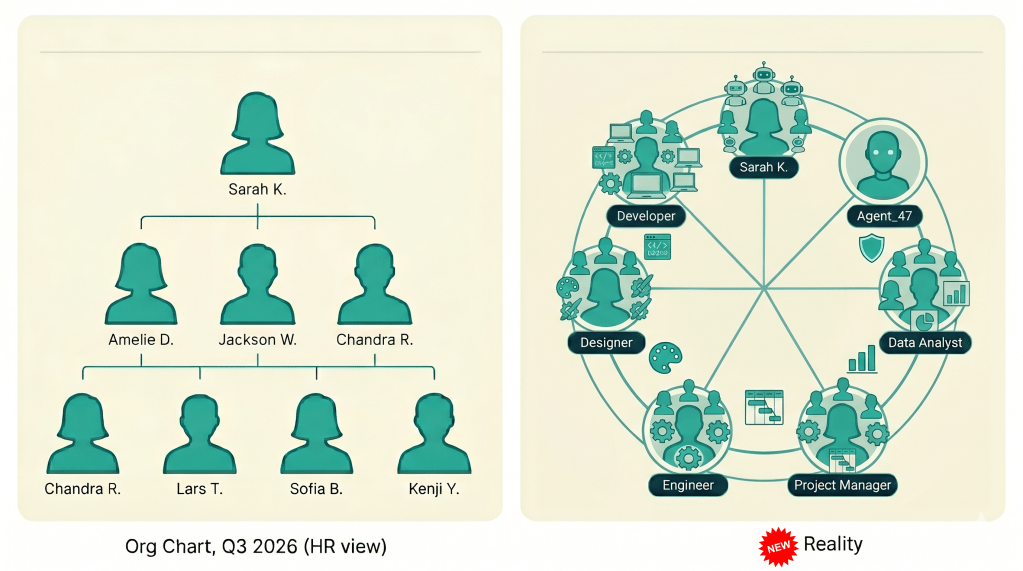

And That’s a Real Problem
Nobody plans to create chaos.
No manager sits down and thinks: “Let’s give this person 12 goals and see what happens.”
And yet, that’s exactly what happens in most companies. Not in one meeting. Not through one bad decision. But across a year, one layer at a time:
- Performance review → a few goals
- New project → a few more
- Promotion track → a few more
- Company OKRs → a few more
- Manager priorities → a few more
Each one makes sense on its own.
Together, they create something nobody designed: fragmentation and confusion.
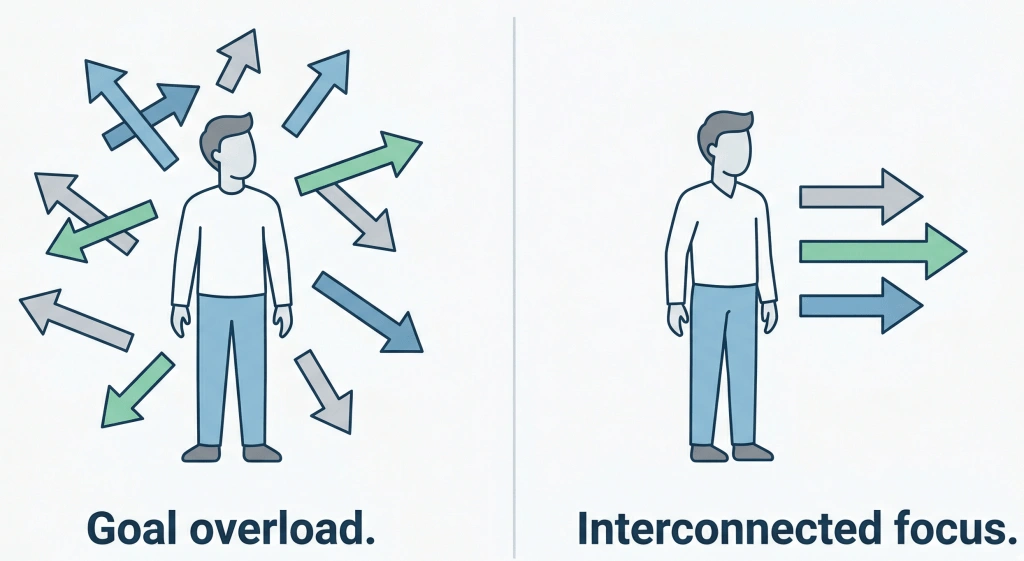
The issue isn’t alignment. It’s interconnectivity.
Most companies aren’t ignoring alignment, they’re actively trying to achieve it. OKRs cascade from company to team to individual. Managers hold 1:1s. HR runs goal-setting workshops.
And it still doesn’t work.
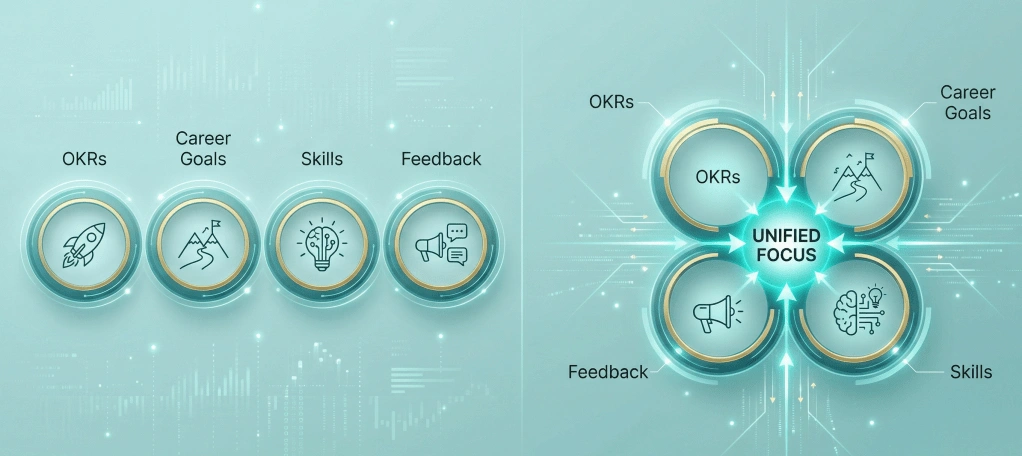
Here’s why: goals are created in different moments, stored in different systems, and managed by different people. They never get reconciled into a single picture.
- OKRs live in one tool;
- Career development lives in another;
- Skill gaps sit in a spreadsheet someone made last quarter, and modified last week;
- Feedback lives in conversation notes, or nowhere at all.
None of these talk to each other. So instead of clarity, people end up with multiple, competing versions of what matters.
And the cost is measurable: only 40% of employees can clearly connect their goals to company objectives.
6 in 10 people are working without a clear line of sight to what actually matters. (McKinsey, 2025)
More goals, less progress
When employees juggle multiple competing goals simultaneously, research shows they tend to focus on just one, abandoning the others, or defaulting to whatever feels easiest to complete rather than most important. (Harvard Business School, Ordóñez et al.)
More goals don’t create more output, and for sure not more outcome. They create more noise.
This shows up at the top of the org too.
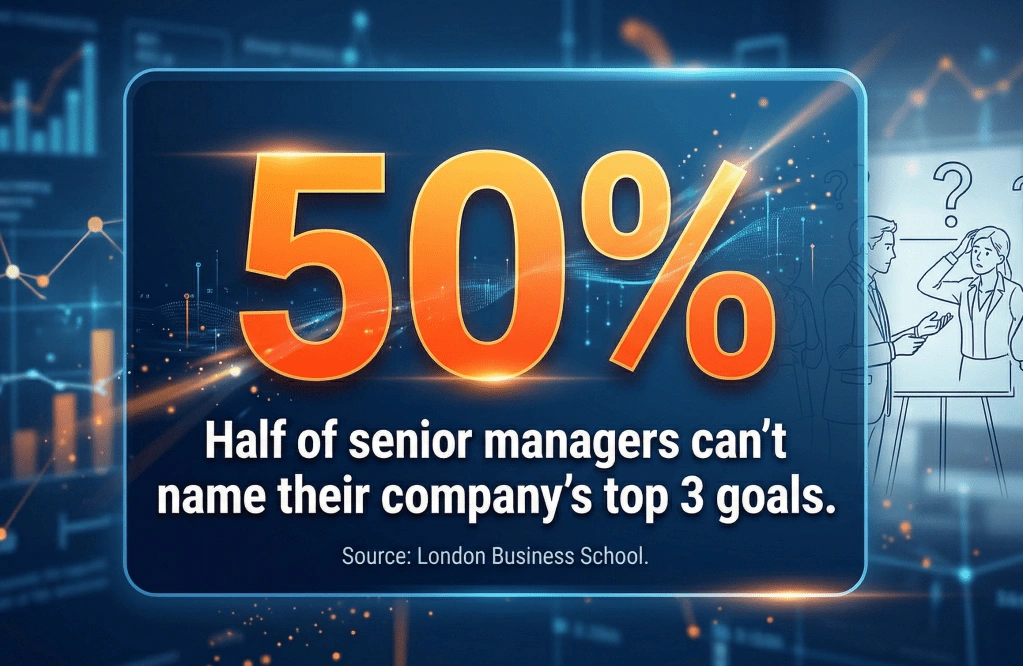
Half of senior managers cannot name their organization’s top three priorities. (London Business School)
If leadership can’t articulate focus, the rest of the organization has no chance of executing it.
Where most frameworks fall short
The standard goal-setting cascade Company > Team > Individual is useful. But it’s incomplete.
It misses two dimensions that matter enormously at the individual level:
- Career direction: what this person is trying to become over the next 1–3 years.
- Skill development: what they need to get meaningfully better at right now.
Neither of these lives inside OKRs. They emerge from promotions, feedback, coaching conversations, and career discussions. And because they happen in separate channels, they never get integrated into someone’s actual working list of priorities.
The result: someone can be perfectly “aligned” on paper and still feel like they’re running in three directions at once.
The real problem: goals are additive, not curated
Every new moment in an organization’s year adds goals. Almost nothing removes them. Nothing connects them globally. Nothing asks the harder question: given everything this person is working on, what should actually come first?
So people accumulate 10+ active goals, conflicting time demands, and constant context-switching. And execution slows down. Not because people aren’t working hard, but because effort without prioritization is just expensive noise.
This is reflected in engagement data.
Global employee engagement fell to 21% in 2024, matching pandemic-era lows, costing an estimated $438 billion in lost productivity. (Gallup, State of the Global Workplace 2025)
Goal clarity, or the lack of it, is one of the primary drivers.
What interconnectivity actually means
Interconnectivity is not alignment 2.0. It’s a different framing entirely.
Alignment asks: “Are these goals pointing in the same direction?”
Interconnectivity asks: “Do all of these goals actively contribute to a single, evolving focus, and does that focus update as the world changes?”
That requires more than a shared strategy doc or a quarterly OKR review. It requires:
- One system, not five
- One prioritized list, not many competing ones
- Continuous recalibration, not static annual planning
At any given moment, a person should be able to look at their work and see one coherent picture: here’s what I’m focused on, here’s why it matters, here’s what I should do next.
Why this especially matters at scale
The growth stage is where goal fragmentation becomes a structural problem.
Starting at mid-size, complexity increases faster than the process can keep up. The informal coordination that worked at 50 people doesn’t scale. Alignment starts breaking at the seams, and too many disconnected goals stop being an individual inconvenience and start becoming an organizational drag.
Interconnectivity at this stage creates disproportionate impact, because you’re building the operating model that will carry the company through the next phase.
How Branco approaches this differently
Most performance tools add another layer. Branco is built around a different idea: goals should merge, not multiply.
Rather than creating another destination for goals to live, it brings everything together (company objectives, team priorities, manager input, career aspirations, skill gaps, feedback) and resolves them into one unified action plan. One prioritized, living list that stays under a meaningful threshold, so people aren’t operating under the weight of everything at once.
As inputs change (a new project, a piece of feedback, a shift in company direction) the system updates. Not quarterly. Continuously. For everyone.
In pure Branco style, these are drafts and suggestions, but fully automated and ready for review: you keep control of what matters.
The final thought
Your people don’t lack ambition. They don’t lack effort.
They have too many disconnected versions of what matters, and no system to reconcile them.
The solution isn’t better goal-setting. It’s connecting the goals you already have into something a person can actually act on.
If you want to see what a unified, evolving focus system looks like in practice, sign up for free at Branco.ai.