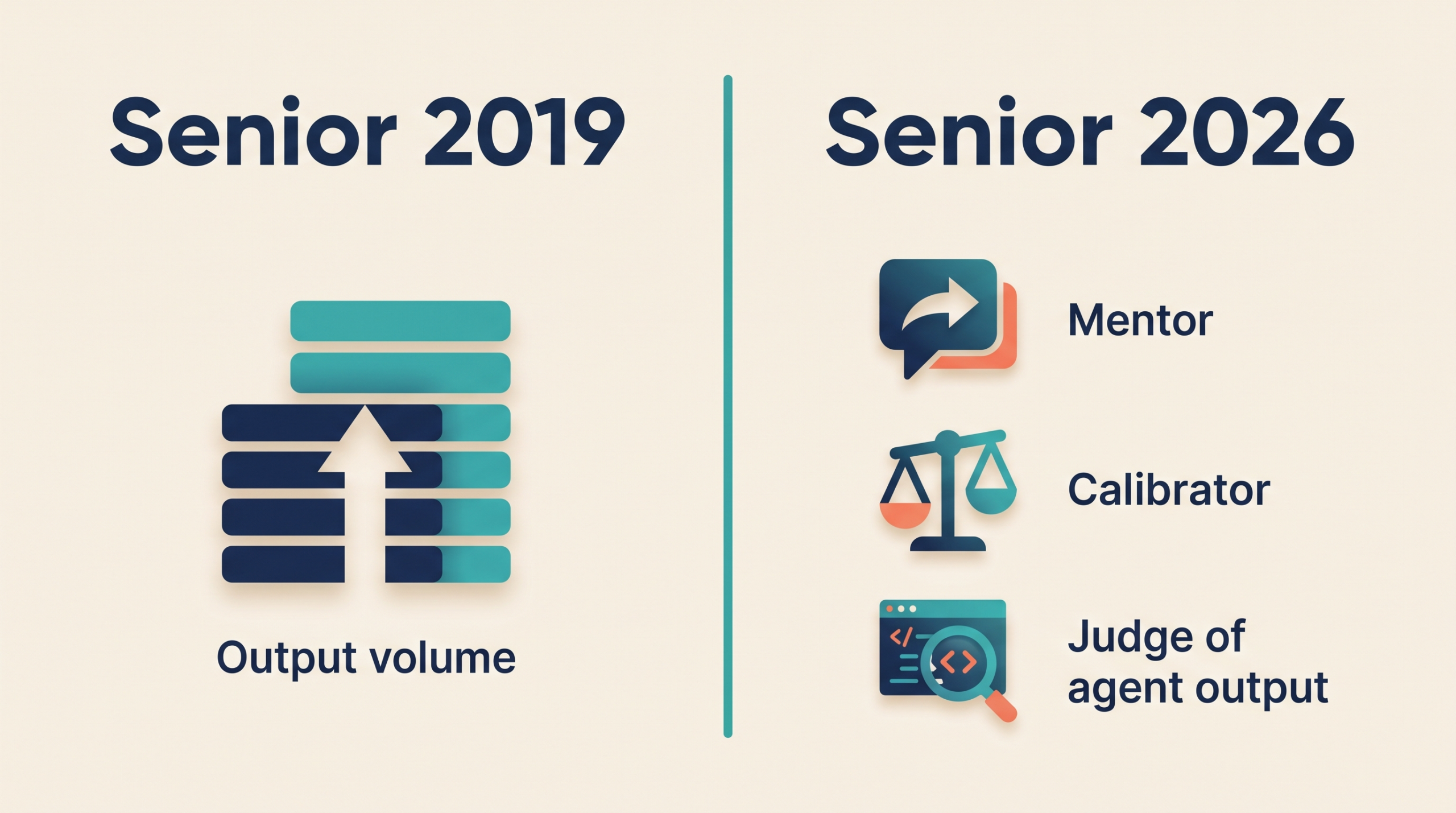

Stop counting what you shipped. Count who got faster.
“Stop counting what you shipped. Count who got faster.”
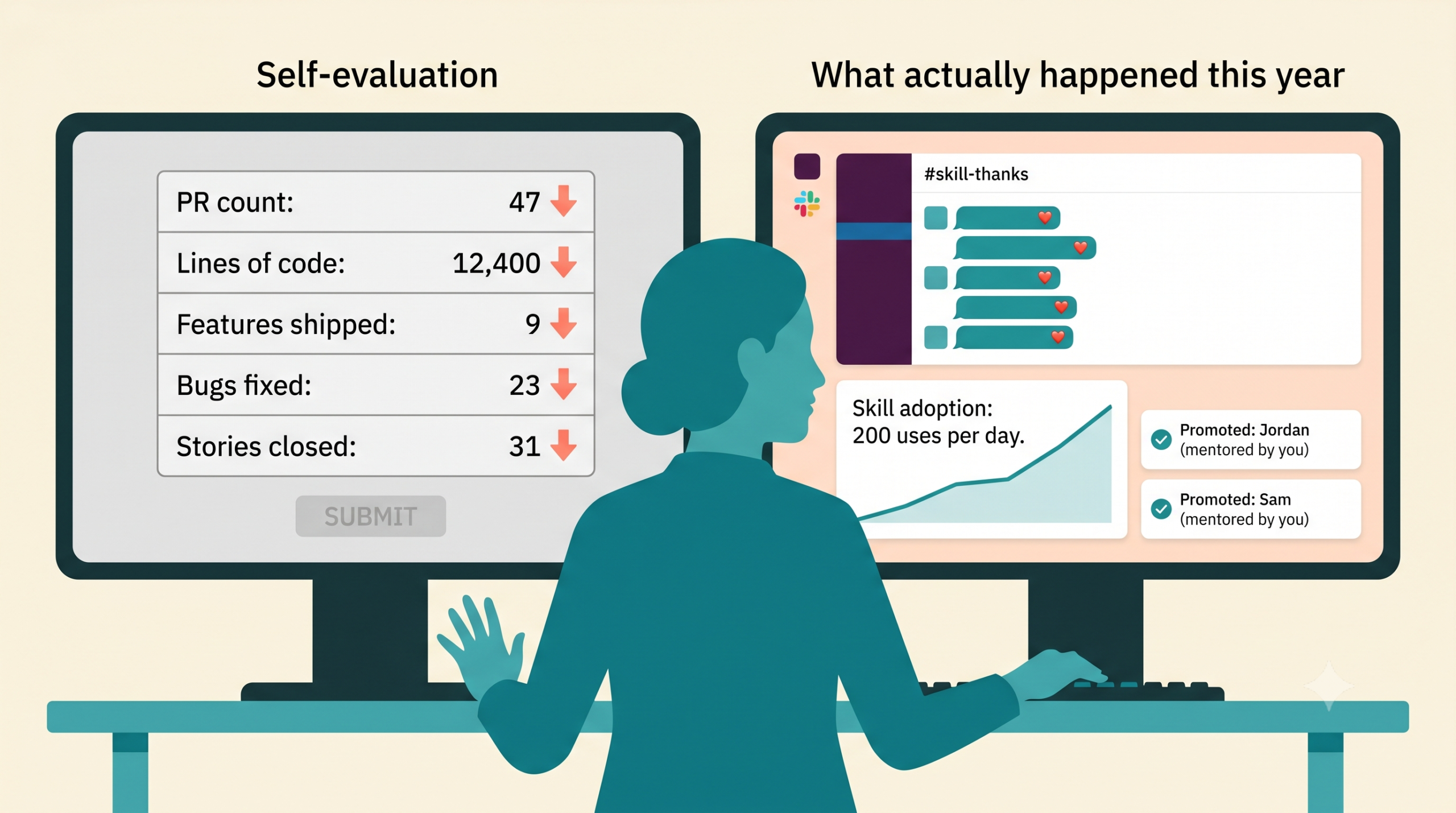
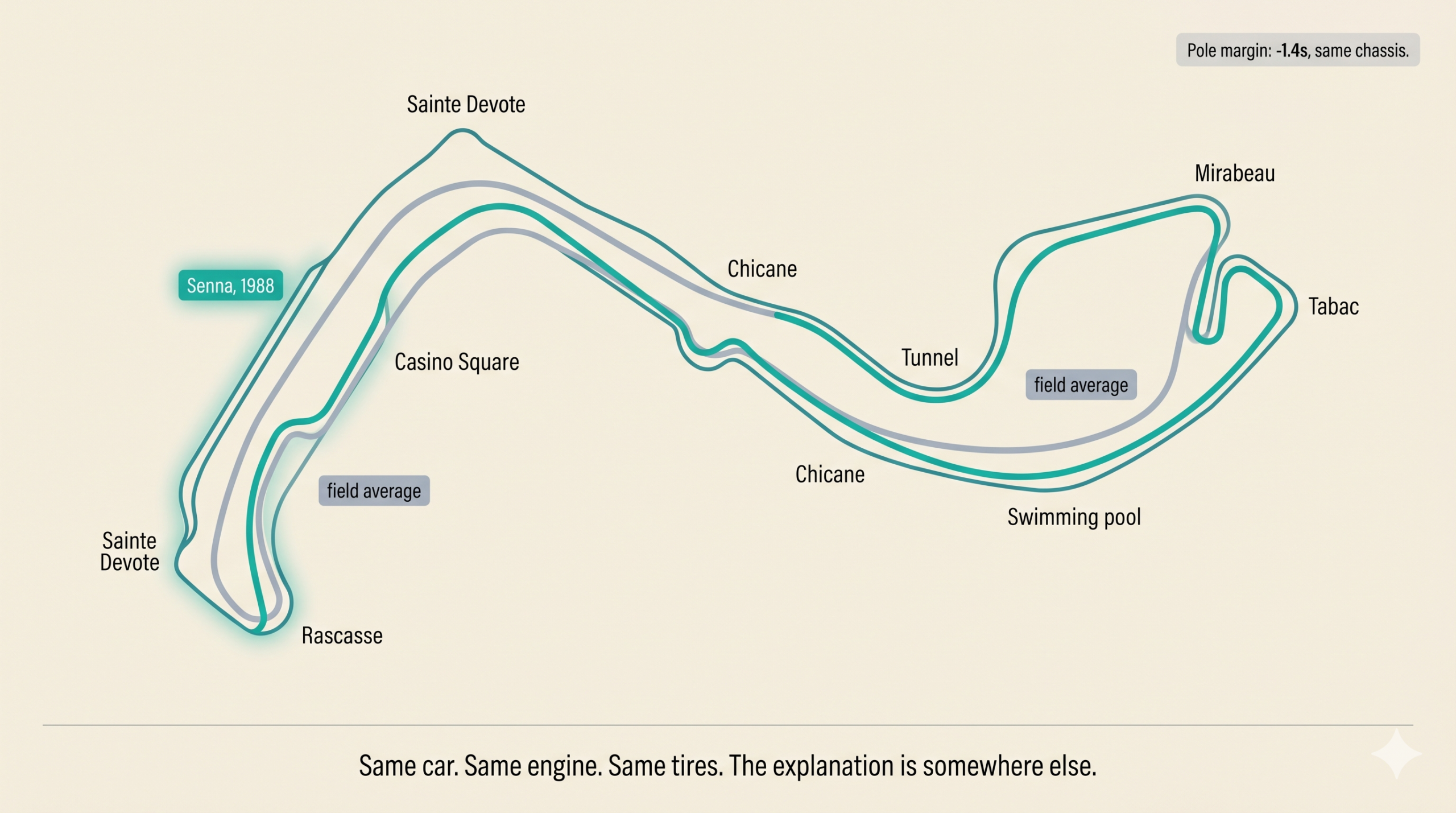
October. A senior IC writes her year-end self-evaluation. Last year she shipped fourteen features. This year, nine. Her PR count is down thirty percent. Her line count is down by half. She types and hesitates.
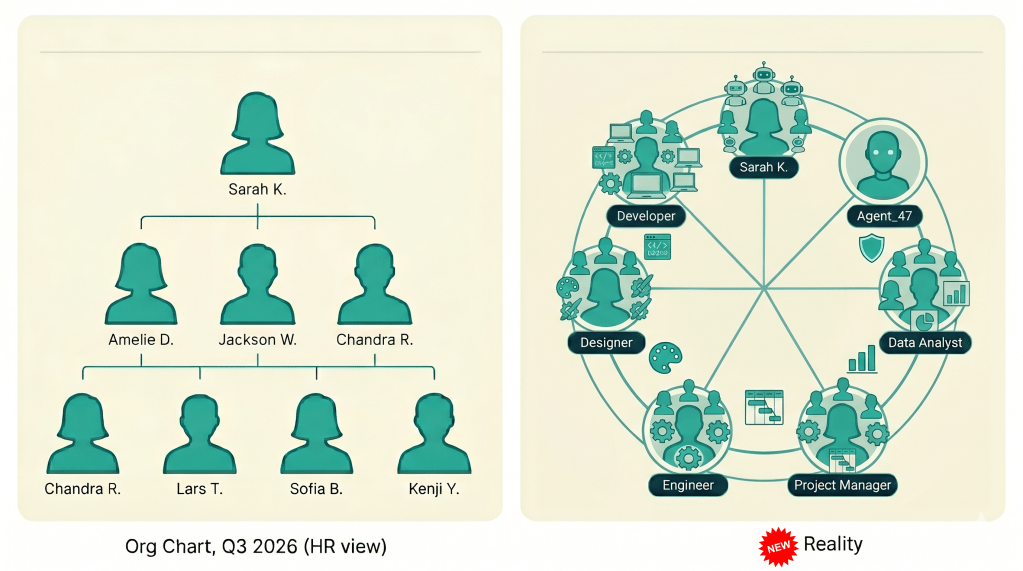
She knows the dashboard her manager will open at calibration. It is the same dashboard her manager has been opening for ten years. She has the wrong dashboard.
Last spring she wrote a small file. A Claude Skill her team now uses two hundred times a day. She mentored two juniors who got promoted last cycle. Her team’s throughput is up by three. The Slack channel where engineers thank her for the rule file has its own emoji.
None of that is on her self-evaluation. None of that is on the manager’s spreadsheet. The two of them are about to walk into calibration with the wrong evidence.
The advice to “ask for the promotion” is three rungs out of date. The work that earns it is being done quietly by people who never ask.
The path is non-linear. Sponsorship is the multiplier.
The standard advice still survives. Build evidence for six months. Review it monthly with your manager. By the time you walk into the room, the case has been made in a hundred small moments.
That part is right.
What changed is the kind of evidence that compounds.
McKinsey and Lean In ran their eleventh annual Women in the Workplace study in 2025. Three million employees, one hundred twenty-four organizations. The single result that traveled was about sponsorship. Employees with sponsors are nearly twice as likely to be promoted as employees without them (McKinsey/Lean In, 2025). Across the cohort, sponsorship moved the needle more than any explicit performance variable.
Coqual published the underlying mechanism in The Sponsor Dividend. Senior leaders who actively sponsor others are 53% more likely to be promoted themselves. Middle managers with proteges win stretch assignments 60% more often than their peers (Coqual, 2024). Sponsorship is a rare multiplier. It compounds in both directions. You do not lose by giving it. You gain.
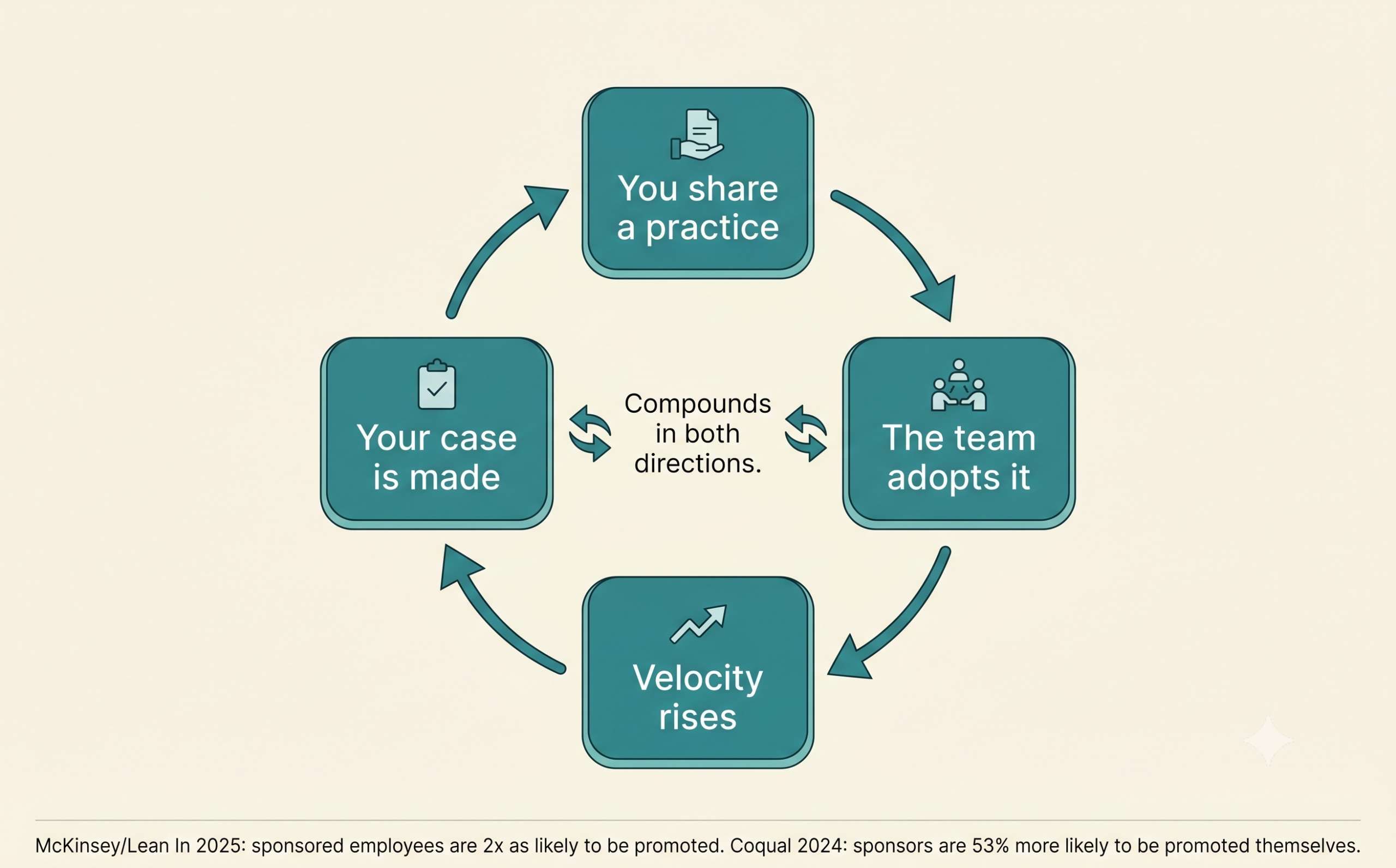
That part of the data was true before agents. It is more true now. The marginal cost of sponsoring has dropped to zero. Encode the practice that took you three years to learn. Drop the document in the team channel. Anyone can use it. The Slack thread of people thanking you for the rule file is sponsorship in a new form.
The non-linear path has a name now. Helen Tupper and Sarah Ellis called it the Squiggly Career. Will Larson’s Staff Engineer archetypes (Tech Lead, Architect, Solver, Right Hand) named the same shape for engineers (Larson, 2021).
A note on the counter-argument. Output still predicts the promotion. Benson, Li and Shue at NBER showed that doubling a salesperson’s pre-promotion sales lifts promotion probability by 14.3%. The catch is also in their paper. Those same high-output promotees then caused a 7.5% drop in their subordinates’ performance (Benson et al., 2018). Output predicts the promotion. It does not predict the next role.
Gartner reads it the same way. Moving an employee from medium to high potential lifts promotion likelihood by about 75%. The equivalent performance jump moves the needle by only 27% (Gartner, 2024). Potential beats performance as a promotion predictor.
The promotion case in 2026 is a potential case. Potential is what compounds.
Super ICs are sharers and delegators
Thariq Shihipar is an engineering lead at Anthropic. He works on Claude Code. Not a manager. Not a founder. An IC who builds for engineers.
In March 2026, after cataloguing the hundreds of Claude Skills Anthropic uses internally, Shihipar published a public post. Lessons from Building Claude Code: How We Use Skills. It distilled the team’s craft into a nine-category framework. Within weeks, the framework became the way other Anthropic teams organized their Skills. Outside the company, it became the public reference cited across the field (Anthropic, 2026).
His own line.
“Skills with a Gotchas section measurably improve Claude’s accuracy. It’s the single easiest win.”
That sentence is engineering judgment in twelve words. He shared the judgment. Hundreds of engineers got better at writing Skills the next day. That is what sponsorship looks like in 2026.
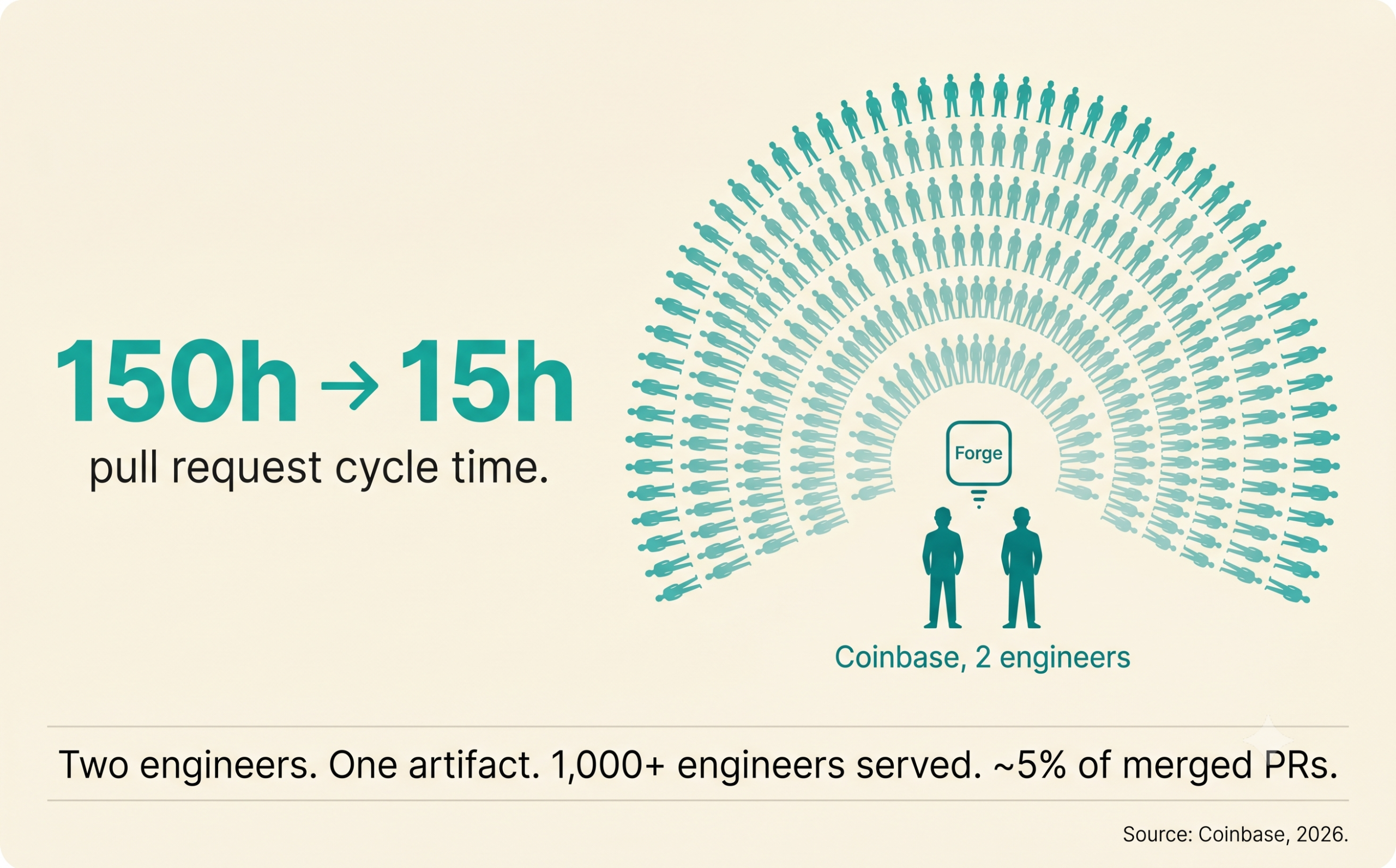
Coinbase has the quantified version. Two engineers at Coinbase built an internal bot they originally called Claudebot, later renamed Forge. Forge now serves more than a thousand engineers across Slack, Linear and MCP. It cut the average pull request cycle from one hundred and fifty hours to fifteen. It ships roughly five percent of the company’s merged pull requests (Coinbase, 2026). Two named engineers. One artifact. A 10x reduction in cycle time across the engineering org.
Independent corroboration came from a University of Chicago study. Once one IC’s Cursor configuration becomes a team’s default, the team merges thirty-nine percent more pull requests (Sarkar, 2025).
The pattern is not engineering-only. An OstraconAI sales team built six Claude Skills for B2B prospecting. The Skills now run two to three days of work per rep, automatically, every week. SyncGTM’s reps using shared Skills recover three or more hours of admin a day. The named IC inside those teams is harder to identify, which is a fair caveat. The shape of the work is the same.
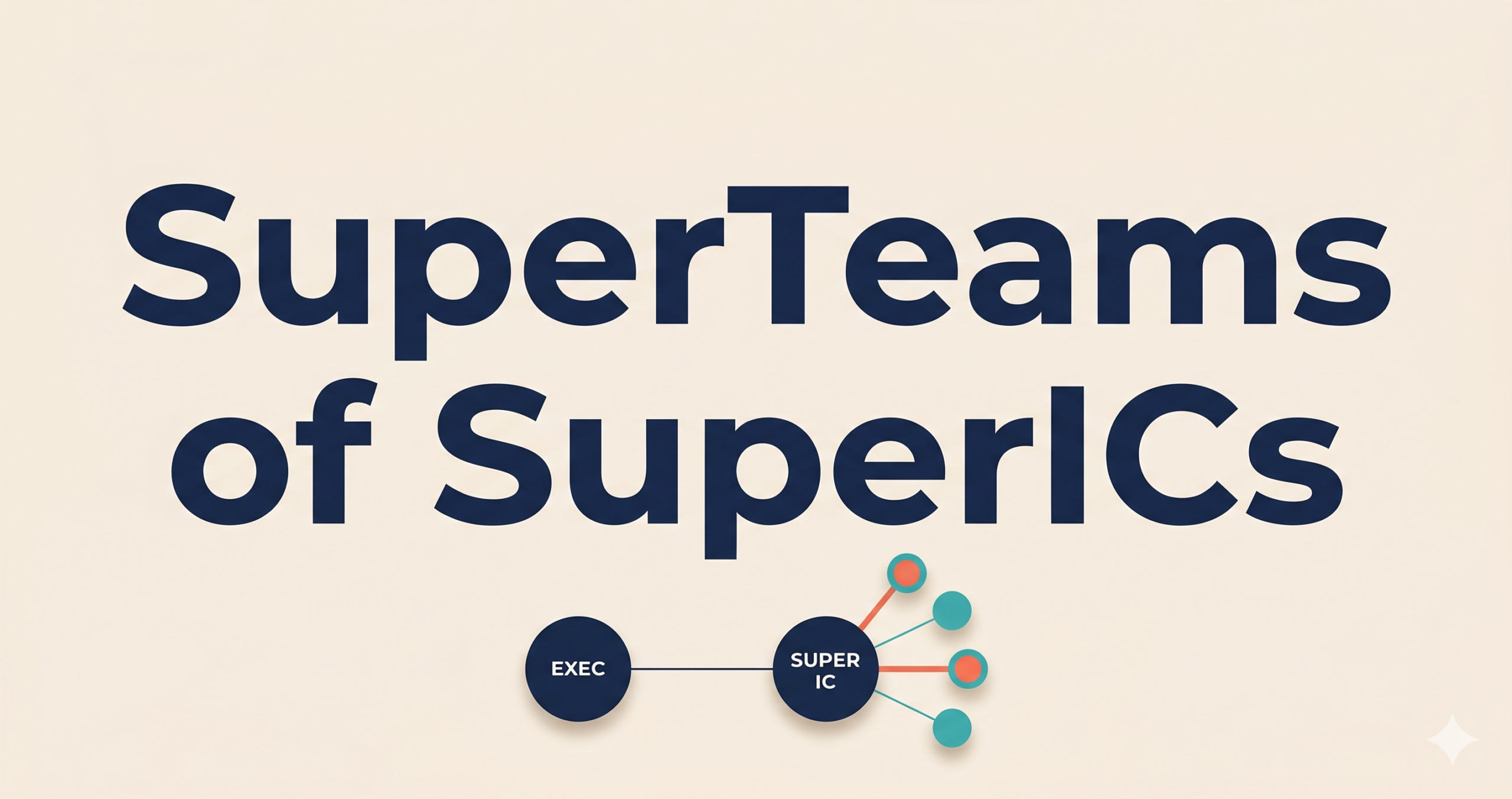
The thing that compounds, for an IC in 2026, is not writing more code or running more campaigns or closing more deals alone. It is encoding your best practice into infrastructure that the team uses by default. That is the multiplier. That is the sponsorship. It is also the most promotable work an IC has done since the apprenticeship was the job.
Delegation is craft. Restraint is its sign.
There is a technical layer here. Super ICs do not delegate to one agent that does everything. They delegate to a fleet.
Anthropic’s engineering team published the data in June 2025. Their multi-agent research system uses a lead agent that spawns three to five specialized subagents, each with its own context window, its own narrow toolset, its own structured return. On their internal research evaluation, the orchestrated fleet outperformed a single-agent Claude Opus 4 by 90.2% (Anthropic, 2025).
The architectural reason is in their own words.
“Subagents function like specialized research assistants, each working independently within their own context windows before feeding the most essential discoveries back to the main agent.”
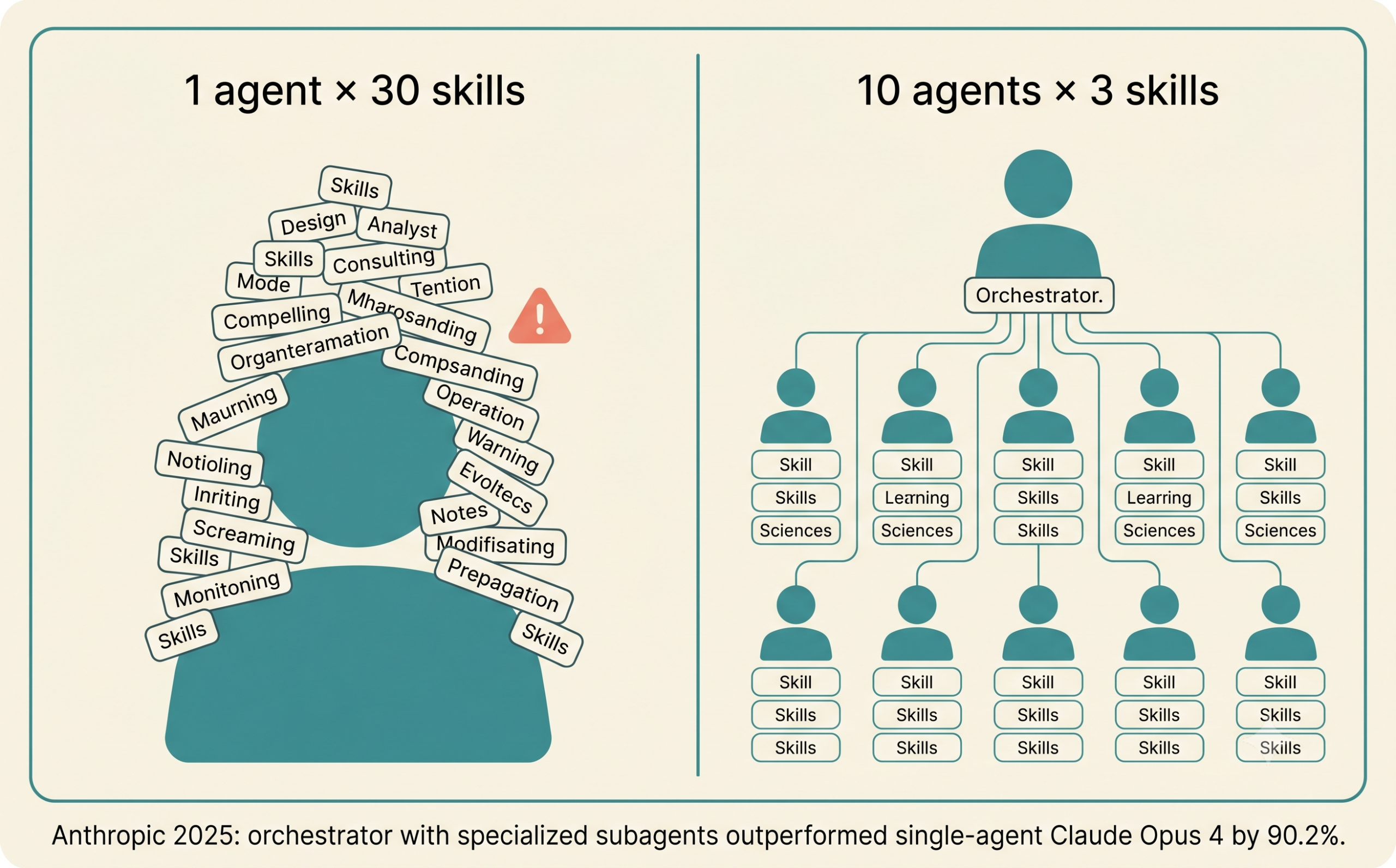
Cursor 3 shipped the same pattern in April 2026 for code. An Agents Window runs specialized async subagents in parallel git worktrees. One coordinator. Many narrow workers. Each worker scoped to a defined task.
The honest counter is also from 2025. Walden Yan at Cognition AI wrote Don’t Build Multi-Agents. For tasks with write actions and tightly coupled design decisions, like coding a single feature, multi-agent decompositions are fragile. Their Flappy Bird example showed one subagent building a Mario-style background while another built an off-spec bird. Neither saw the other’s implicit choices. Their rule: share full context, share full agent traces, keep writes single-threaded (Cognition, 2025).
The two papers add up to a craft principle. Delegate broad and parallel for read-heavy work. Stay tight and single-threaded for write-heavy work with coupled decisions. Either way, the Super IC is choosing the architecture. The IC who delegates nothing, on the theory that no agent can do their job, is the IC who cannot scale and will not be promoted.
Restraint is the sign that the IC understands the choice.
SmartBear and Cisco published the canonical study on review size in 2006. Across two thousand five hundred reviews and three point two million lines of code, defect detection held at seventy to ninety percent for pull requests under four hundred lines. Above four hundred lines, detection collapsed (Cohen, 2006). That was true twenty years ago. It is more true now. Reviewers have less time, and agents can produce more code than any reviewer can read.
Apiiro published the 2026 update across Fortune 50 enterprises. AI coding assistants delivered roughly 4x faster velocity. They also delivered roughly 10x more security findings. A 322% increase in privilege escalation paths. A 153% increase in design-level flaws. A 2.5x increase in CVSS 7.0 and higher vulnerabilities (Apiiro, 2026). GitClear’s 2025 study across 211 million lines of code shows the same shape. Copy-pasted lines rose. Refactored lines fell. Two-week churn rose.
Kelsey Hightower put the rule shorter.
“Some of the best engineers I’ve ever seen write no code at all.”
Adding a thousand lines every commit is not elegance. It is a run towards tech debt. The Super IC’s promotion case shows the opposite. Small. Surgical. Restrained. The kind of work that a manager would have caught and approved before AI made volume cheap. The kind of work that still earns trust.
How Branco helps
Branco is the operating layer for the multiplier evidence. The four prerequisites still hold. Clear goals. Clear expectations. Continuous feedback. Visibility. What changed is the kind of evidence the visibility layer surfaces.
- Sponsorship visible. Who mentored you. Who you mentored. Who got promoted because of you. Evidence accumulates as a record, not as a memory in your manager’s head.
- Sharing artifacts tracked. The Skill. The rule file. The playbook. With adoption counts and the team velocity that followed.
- Delegation as a competency. Behavioral markers at each level for what good delegation looks like, including agent fleet architecture choices.
- Restraint signals. What the IC did not ship. What they simplified. What stayed small on purpose.
HR’s move this quarter is concrete. Add “sponsorship received” to the promotion packet template. Add “shared artifact adoption” to the calibration scorecard. Both lines are observable. Neither requires another tool.
What this looks like this week
If you are a Head of People, add the two lines above to your rubric this quarter. Sponsorship received on the promotion packet. Shared artifact adoption on the calibration scorecard. Brief the managers in your next staff meeting.
If you are an engineering or product manager, walk your staff-plus ladder this week. For each name, ask one question. What did this person encode for the team this quarter. If the answer is nothing, that is the signal.
If you are an IC, pick one practice you do well. Encode it as a Skill, a rule file, a sub-agent, a playbook. Drop it in the team channel. Track who uses it. Watch your team’s velocity for the next eight weeks. That is your Q3 promotion package, written without a word said about promotion.
Stop counting what you shipped. Count who got faster.
Old promotion case: I shipped X.
New promotion case: This team’s velocity is 3x because I built Y that they use by default.
Stop asking for the promotion. The work is making the case.
If you want to see what multiplier evidence looks like in practice sign up for free at Branco.ai.
Related reading
- The H in HR Now Stands for Hybrid
- The Last Fast IC
- Beyond Skills: The Real Promotion Playbook
- Career Growth Toolkit 1: The Package
Sources and further reading
- McKinsey & Lean In (2025), Women in the Workplace 2025
- Coqual (2024), The Sponsor Dividend
- Anthropic (2026), How Anthropic Uses Claude Code Skills (Thariq Shihipar)
- Anthropic Engineering (2025), How We Built Our Multi-Agent Research System
- Apiiro (2026), 4x Velocity, 10x Vulnerabilities