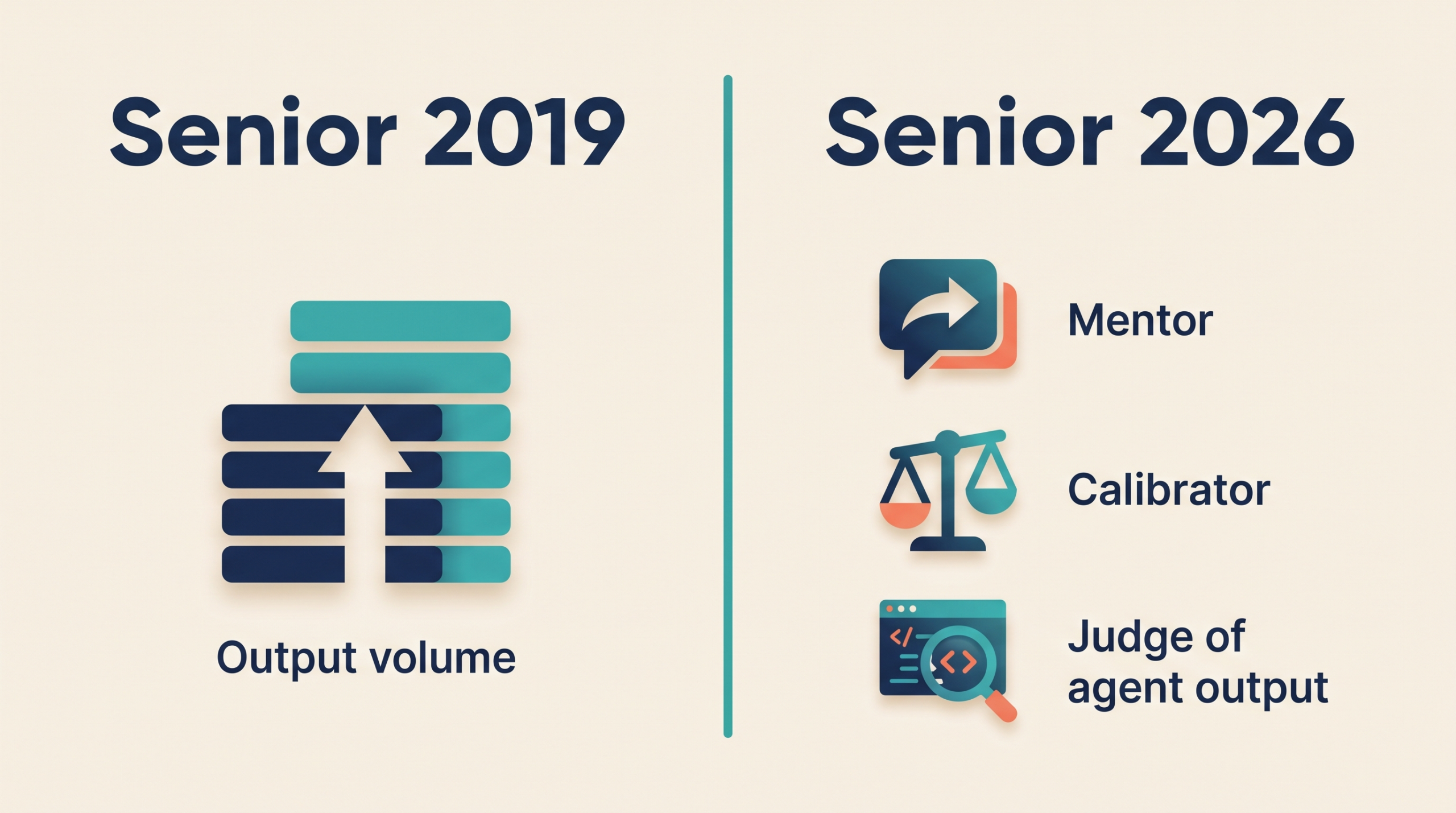

If your core knows what’s needed to build a complete team, you may already have a complete team. The unit of org design has collapsed, and HR is the construct that holds it.
Neo lies on a table, eyes flickering. Tank loads the program. Neo opens his eyes and says, “I know kung fu.” Morpheus answers, “Show me.”
In 1999 that scene was science fiction. In 2026 it is a Tuesday standup.
A founder logs in. The agent has read the codebase, drafted the migration plan, set up the schema, and run the tests overnight. The founder writes back: show me. Three hours later, the work is in review. No new hire. No new headcount line. A whole capability, on tap.
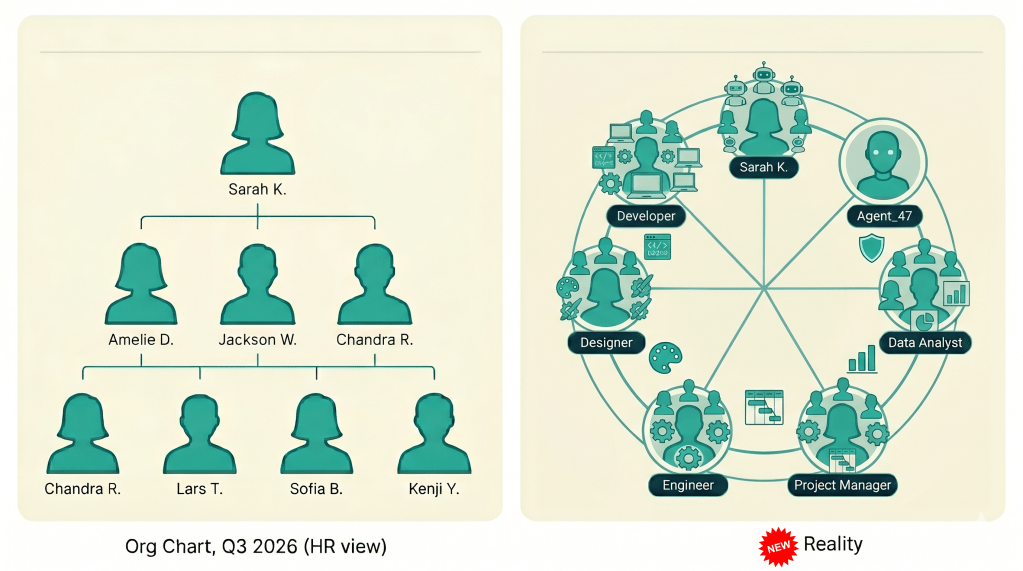
The org chart didn’t shrink. It collapsed inward.
This is the next chapter of the arc that started with The Last Fast IC, ran through The H in HR Now Stands for Hybrid, and landed last week on the seam in Who reviews the AI teammate?. The archetype is the SuperIC. The new unit they form is the SuperTeam. The question every leader needs to sit with this quarter is what those two facts do to your org design.
The complete-team paradox
For a decade, “we don’t have a complete team” meant one thing: we need to hire. A growth lead. A second backend. A junior designer to cover the surface area. The headcount plan was the org design.
That meaning is breaking, and the data is loud.
Time to first hire inside a startup’s first year has lengthened by nearly 49% since 2019. In the same window, median first-six-month revenue at Atlas startups jumped 39% year-over-year in 2025, and 20% of new companies landed a paying customer within 30 days of incorporation, up from 8% in 2020 (Stripe Atlas, 2025). Founders are staying solo longer, on purpose, and the revenue is decoupling from the headcount.
Read that twice. Time-to-first-hire is up. Revenue per founder is up. Time-to-first-customer is down. The “complete team” needed to ship the first product is smaller than it has ever been.
“We don’t have a complete team” now means something different. It means: we don’t yet know which capabilities to wire up as agents, which judgment calls to keep human, and which two or three archetypes to actually hire. The vacancy on the org chart is not a role. It is a configuration.
Most leaders read this as a hiring story. It isn’t. It is an org-design story, and the chart on the wall is two quarters behind reality.
Skills aren’t the differentiator. Alignment and judgment are.
Here is the part most people skip. A capability on tap is not a teammate. The kung fu loads, the body still has to fight. The differentiator stopped being the skill. The differentiator is the judgment that routes the skill, and the alignment that points the judgment at the same outcome.
That sounds abstract. It isn’t. McKinsey describes the new shape concretely: two to five humans can already supervise 50 to 100 specialized agents running an end-to-end process, from onboarding a customer to closing the books. The human role moves from execution to orchestration, trade-off, and exception handling. Two archetypes are emerging: the M-shaped generalist-orchestrator, and the T-shaped deep expert who safeguards quality at the edges (McKinsey, 2025).
In other words: a team of three humans can now do what a team of fifty used to do. But only if those three humans have higher-grade alignment, sharper judgment, and a system that keeps both visible. The skills part is solved. The human part got harder, not easier.
This is where HR stops being hygiene.
The people practices that ran a 50-person org cannot run a SuperTeam. An annual review cycle, a 9-box grid, a Q4 calibration ceremony, a 1:1 cadence that drifts whenever delivery gets hot: those were “good enough” in 2018. They are not good enough now. The quality bar moved with the team shape, and most HR functions have not caught up.
your enemy is not the competition, you don’t really have competitors, your enemy is the good enough
An investor I trust told me once. He meant product. It reads even harder when you point it at people practices. A SuperTeam’s compounding edge is judgment and alignment. “Good enough” alignment leaks ten times faster when the team is three humans supervising eighty agents. “Good enough” feedback decays before the next quarterly review. “Good enough” calibration drops your best orchestrator off the ladder, because there is no row for what they actually do.
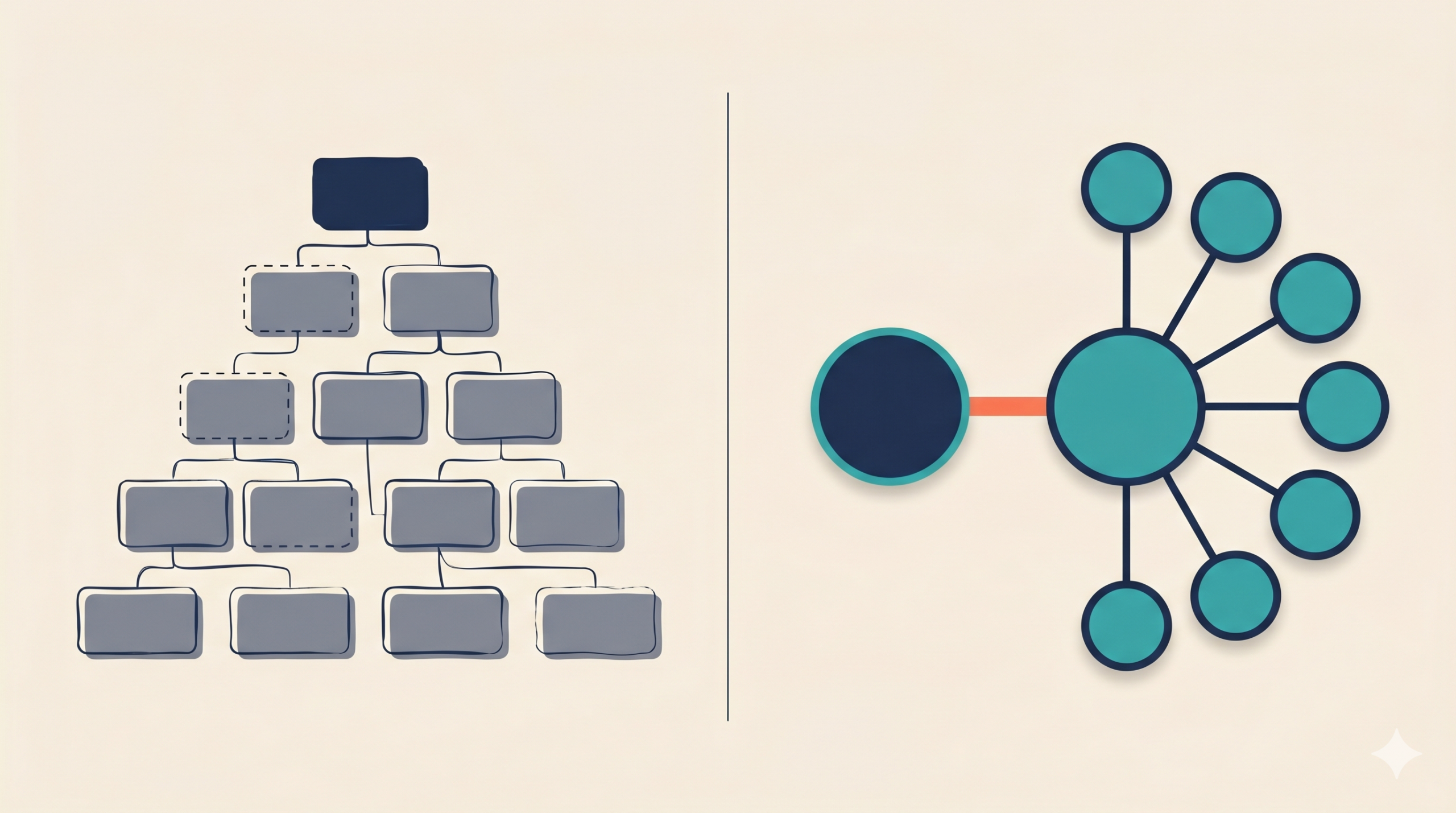
The two-pizza team rule collapsed upward
For twenty years the two-pizza rule sat at the bottom of the org chart. Small teams ship fast. Keep them under nine. The exec team sits above them, sets direction, reviews progress, removes blockers.
That model is inverting. The two-pizza team is colliding with the exec team. The exec team IS the execution team now, working directly with an agentic surface that used to be a department.
Cursor (Anysphere) went from $100M ARR in January 2025 to roughly $3B ARR by May 2026 with around 300 employees (The Information, 2026). The top ten AI-native startups average $3.48M in revenue per employee, roughly 5.7 times the leading-SaaS average, on a median team size of 24 (Owyang, 2025). At that shape, you can fit the entire company in a single all-hands. The CEO is two desks away from the agent that just shipped a feature. The VP of Product is the PM. The Head of Eng is on the PR.
If you’re a senior IC reading this and waiting for the layoff angle: it isn’t here. This is a structural promotion, not a structural cut. The SuperIC stands peer to the exec team in this construct, not below it. The level-guide row sits next to “VP of Engineering,” not three steps under it. Scaling now means scaling the scalers, not adding layers below them.
Picture a five-person company doing $25M ARR. Or a 50-person company doing $250M. Both are real shapes in 2026. In both, the question every Monday is the same: which capabilities do we wire up as agents this week, which judgment calls do we keep, which one new hire do we make this quarter, and how do we keep all of them aligned and visible to each other.
That question used to belong to the COO. It now belongs to a SuperIC and a Head of People sitting in the same room.
How Branco helps
Branco is the Construct for SuperTeams. Goals, expectations, feedback, and visibility on one ledger across humans and agents, at a quality bar “good enough” practices can’t reach.
- One ledger across humans and agents. Strategy, OKRs, and weekly outcomes flow on the same surface, so a three-person SuperTeam supervising 80 agents has one place to see what’s aligned and what’s drifting.
- Continuous feedback that survives hot quarters. Lightweight peer prompts tagged to skills and competencies, automated because humans forget, so the 1:1 stops being the data-gathering call and becomes the decide-and-route call.
- A level guide that has a row for the SuperIC. Judgment-under-delegation, agent orchestration, and exception handling are first-class promotion criteria, not bonus points buried in a comment field.
- Calibration that doesn’t lose the orchestrator. The IC whose output compounds through agents gets credited for the judgment, not lost in the volume. The work product is the seam.
- Action plans tied to the archetypes you actually need. M-shaped and T-shaped growth paths, with Small Wins on a target date, so the answer to “scale the scalers” is a system, not a hope.
HR was hygiene at the 50-person org. It is load-bearing at the SuperTeam. That shift is not a tooling upgrade. It is a category change in what the people function does.
What to do this week
Stop counting headcount for a minute. Count the SuperTeams already forming bottom-up inside your org. The founder running marketing solo with a fleet of collaborating agents. The growth team spinning up a second testing squad in an afternoon, not a quarter. The ops team closing the books with two humans and a fleet of bots.
They are the unit of org design now. The question is not how many of them you have. The question is which two or three archetypes are missing, and what “good enough” practice is quietly costing you the ones already inside the building.
The kung fu is loaded. Show me.
If you want to see what a Construct for SuperTeams looks like in practice, sign up for free at Branco.ai.
Related reading
Who reviews the AI teammate? A performance management playbook for hybrid human-agent teams
The H in HR Now Stands for Hybrid
The High-Performance Team Myth
Sources and further reading:
- Stripe Atlas (2025) Startups in 2025: Year in Review. stripe.com
- McKinsey (2025) The agentic organization: Contours of the next paradigm for the AI era. mckinsey.com
- The Information (2026) Reporting on Anysphere (Cursor) ARR and valuation milestones. overview
- Jeremiah Owyang (2025) AI startups are dominating traditional software in one key metric. web-strategist.com