Your Skill Matrix is Only Half the Story: The Real Difference Between Skills and Competencies
Have you ever seen a brilliant, highly-skilled colleague (a top-tier engineer, a data-driven marketer, a shark of a salesperson) get stuck? They deliver on the “what,” but they hit an invisible wall when it comes to promotions or broader influence.
The problem isn’t their skills. It’s something deeper, more foundational, and often, completely undefined by their company: their competencies.
Many organizations throw up a skill matrix and assume the job is done. That’s the easy part. But a skill matrix alone is a half-truth. Differentiating between what people can do and how they behave is the key to unlocking meaningful promotions, retaining top talent, and building a high-performance culture that lasts.
What Are Skills and Competencies, Really?
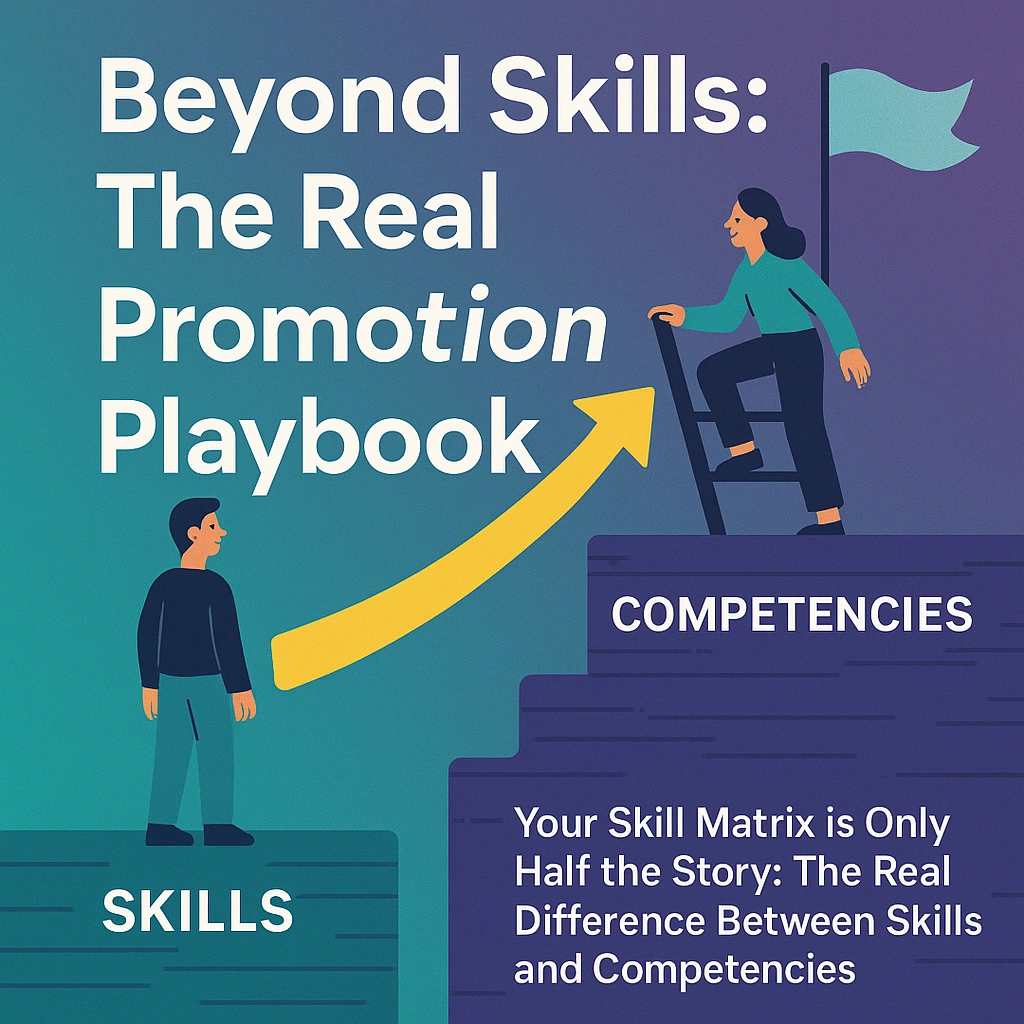
While often used interchangeably, they represent two different, crucial dimensions of performance.
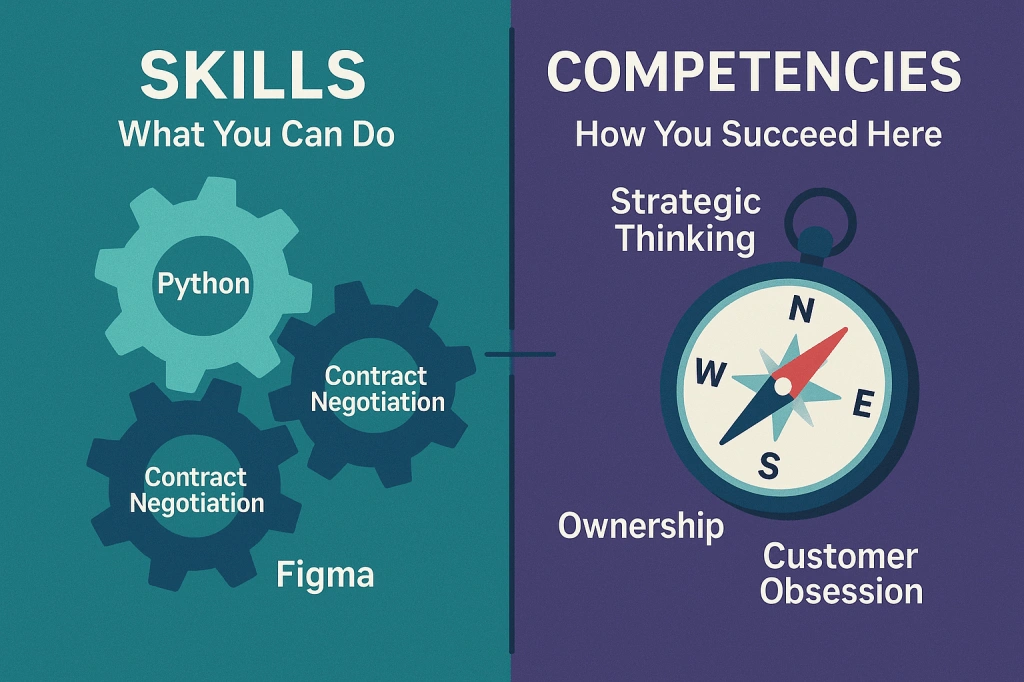
Skills are the ‘What’. They are the specific, teachable, and often technical abilities needed to perform a job. They are functional, concrete, and generally portable between companies.
- Examples: Writing JavaScript, running a financial model in Excel, managing a paid search campaign, or negotiating a contract.
- Who owns them: Your VP of Engineering or Head of Sales can map out the technical skills required for their teams. They are the functional building blocks of a role.
Competencies are the ‘How We Succeed Here’. They are the blend of behaviours, judgment, and contextual application of skills that determine how someone achieves results within your specific organization. They are cross-functional and cultural, translating your values into action.
- Examples: Strategic Thinking, Radical Candor, Bias for Action, High-Ownership Mentality.
- Who owns them: The executive team. Competencies aren’t about what a VP of Sales does versus a VP of Engineering; they are about how any VP at your company should lead, communicate, and make decisions.
Put simply: A skill matrix tells you if an employee can do the job. A competency framework tells you if they will thrive, and elevate others, while doing it at your company.
Why This Distinction Is a Career-Maker (and a Culture-Saver)
Ignoring competencies is expensive. A Gallup report highlights that replacing an employee can cost anywhere from one-half to two times their annual salary. While some turnover is due to a skills gap, a significant portion stems from a mismatch in how work gets done: a cultural and behavioural misalignment.
For the employee, it’s deeply frustrating. They’re hitting their targets but getting vague, personal-feeling feedback like “you’re not being strategic enough” or “you need to take more ownership.” Without a clear competency framework, that feedback is un-actionable and feels like a moving goalpost.
For the company, it’s a massive risk. Promoting someone based on skills alone can erode team morale and poison the culture. When you promote a “brilliant jerk” in a collaborative culture, you signal that toxic behaviour is acceptable as long as you deliver. This is how you lose your best people.
The data is clear: skills get you in the door, but competencies define your trajectory. LinkedIn’s Global Talent Trends report found that an overwhelming majority of talent professionals rate these human skills as equal to or more important than hard skills for long-term success.
The bottom line: Skills get you hired. Competencies get you promoted, retained, and trusted.
Competencies Are Your Culture’s Operating System
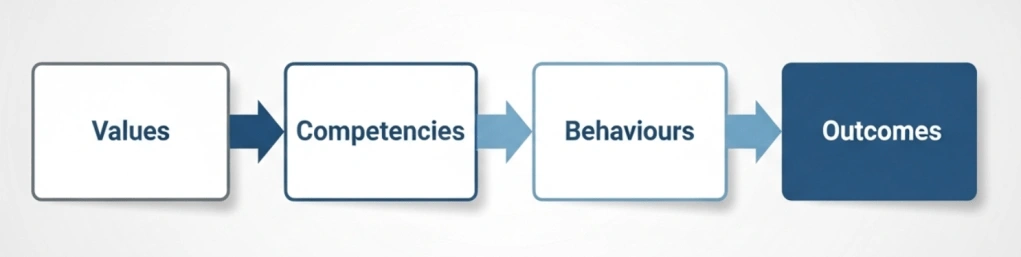
Your company values are not just posters on a wall. Competencies are the bridge that turns those abstract values into a concrete, observable operating system for your culture.
Let’s take a common value: “Customer Obsession.”
- Competency: Works Backwards from the Customer
- Behaviour (Junior Level): “Includes customer data and quotes in project proposals.”
- Behaviour (Senior Level): “Actively seeks out and shuts down projects that don’t solve a core customer problem, even when popular.”
When competencies are defined, they drive consistency and fairness across the entire employee lifecycle:
- Hiring: You screen for company-fit behaviors, not just a checklist of tools.
- Onboarding: You teach new hires how to apply their skills here from day one.
- Performance & Promotions: Objective, leveled behaviours reduce ambiguity and bias, making decisions fairer and more transparent.
- Leadership Continuity: When VPs across Sales, Engineering, and Marketing all share a common definition of “Strategic Thinking,” the signals from the top become coherent.
Without this, companies default to vague “culture fit” calls, and that’s where top talent either gets promoted for the wrong reasons or leaves in frustration.
How to Build a Competency Framework That Works
Building this is a strategic project, not an HR checkbox exercise. Avoid the common traps of outsourcing to a generic vendor or slapping vague adjectives into job descriptions.
- Start with Executive Alignment (Non-Negotiable). Lock your leadership team in a room. They must debate and co-own the 5-7 core competencies that define success. The VP of Marketing and the VP of Product must agree on one definition of “Ownership” at each level. This is the hardest, most important step.
- Maintain Separate, but Linked, Frameworks. You need a Skills Matrix (functional, owned by department heads) and a Competency Matrix (company-wide, owned by the executive team). The magic is in showing how they connect.
- Define Levels with Behavioral Examples. “Communication” is not a competency; it’s a category. Get specific. Show what Level 1 (Junior IC) vs. Level 2 (Senior IC) vs. Level 3 (Manager) looks like with concrete examples of behaviour and outcomes.
- Integrate It Everywhere. A framework that only appears during performance reviews is a PDF tombstone. Weave it into your daily operating system:
- Hiring: Write job descriptions and interview questions around it.
- Feedback: Link all feedback: peer, upward, and downward, to specific skills and competencies. Hopefully you do this regularly, or better with an automated continuous feedback system like Branco.
- Promotions: Make competency demonstration a non-negotiable gate for advancement.
- Instrument and Measure. Don’t rely on self-ratings. Track behavioural evidence from feedback, goal progress (OKRs), and 360 reviews to create an objective picture of readiness and performance.
How Branco.ai Bridges the Gap
Defining and integrating skills and competencies is complex. Spreadsheets quickly become a nightmare of version control, and the work of executive alignment gets lost. Branco is built to make this simple.
We provide the structure to do this right, turning a painful, manual process into a streamlined system for growth.
- Define Both, Clearly: Our platform has distinct, dedicated spaces for functional Skills and cross-functional Competencies. You can build your skill matrices while your executive team collaborates on the core competencies that apply to everyone.
- Facilitate Executive Alignment: Branco provides structured workflows for leadership to define competencies, link them directly to company values, and spell out the behavioural expectations at each level. This creates a single source of truth: no more competing definitions.
- Integrate into Daily Workflows: Competencies aren’t just stored in Branco; they are the backbone of growth. They are pillars in our continuous feedback, linked to goals, and serve as the foundation for Live Promotion Packages and personal development plans.
- Make Growth Visible and Fair: With dashboards that show competency gaps, promotion readiness, and the evidence trails used in decisions, Branco makes growth visible, measurable, and equitable.
You don’t just get a matrix; you get an integrated system that connects your company’s expectations to your team’s daily actions.
Stop talking past your employees with vague feedback. Define what good looks like, in both skills and competencies, and watch your people and your culture thrive.
TL;DR
- Skills = What you can do (e.g., coding, design). They are functional and teachable.
- Competencies = How you succeed here (e.g., strategic thinking, ownership). They are behavioural, cultural, and tied to your values.
- Relying only on skills leads to promotion ceilings, costly turnover, and cultural mismatch. Competencies are the strongest predictors of long-term success and leadership potential.
- Defining competencies is hard work. It requires non-negotiable executive alignment on translating company values into observable behaviors at every level.
- To do it right, integrate your skill and competency framework into every part of the employee lifecycle: hiring, feedback, and promotions.
- Branco provides the structure to define, align on, and integrate both, connecting expectations to daily work and real career, and business, growth.
In case you missed it, the series that started it all:
Career Growth Toolkit #1 – Ownership: The Live Promotion Package
Career Growth Toolkit #2 – Know What Good Looks Like: Expectations Made Clear
Career Growth Toolkit #3 – Alignment: Setting Objectives That Actually Work
Career Growth Toolkit #4 – The Plan: Turning Feedback into Actions
Sources and further reading:
- Cost of Turnover: Gallup. (2022). The High Cost of Employee Turnover and How to Reduce It.
- Skill vs. Competency Frameworks: Society for Human Resource Management (SHRM). Various articles on competency modeling and performance management.
- State of Skills Reports: Data from sources like LinkedIn Learning or Degreed often show the demand for both “hard” and “soft” skills, which can be used to frame the discussion. A 2020 LinkedIn Learning report found that 57% of leaders say soft skills are more important than hard skills.
- Skills-Based Hiring Data: Deloitte, “The skills-based organization: A new operating model for work and the workforce.”
- Future of Skills: World Economic Forum, “Future of Jobs Report.”