Clarity, Choices, and What Your Company Can Actually Support
If you expect your team to know exactly where they’re going in their careers, you’re expecting too much, or rather, you’re expecting the wrong thing.
Here’s the uncomfortable truth: most professionals don’t have a clear vision of their next role, what it takes to grow, or even what’s realistically available in their organization. And that’s not because they’re unmotivated. It’s because most companies haven’t done the work to define and communicate what “good” looks like and where that goodness can lead.
That’s where career paths done right come in.
The Role of Career Paths: Not a Map, but a Set of Roads
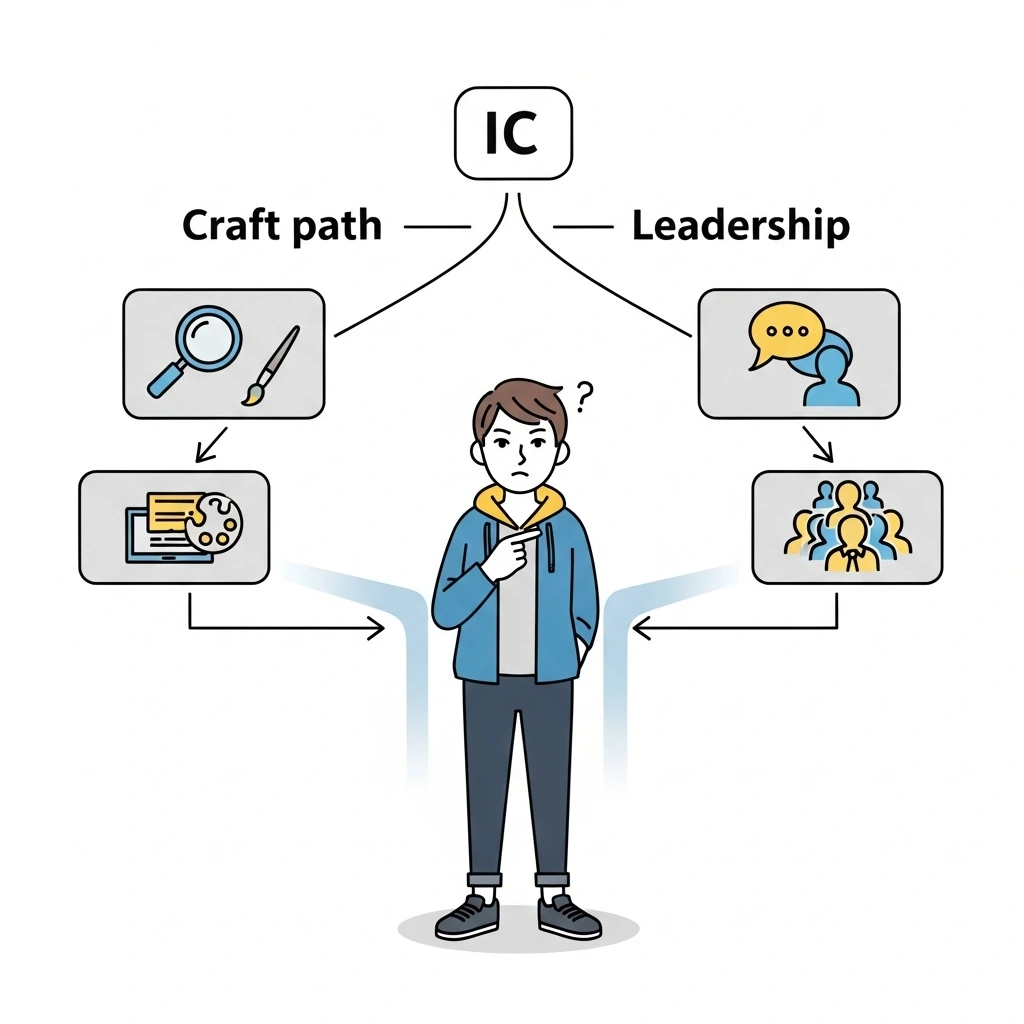
A good career path isn’t a rigid track. It’s a set of visible, structured options shaped by:
- your company’s needs (present and near future),
- your employees’ interests and strengths, and
- a shared language of expectations at every level.
Without that, you leave your people to guess. And that guessing costs you.
📉 Only 29% of employees say they feel supported in their career development (Gartner, 2022).
📉 Two-thirds of employees who quit jobs say a lack of career growth was the reason (McKinsey, 2022).
1. Parallel Paths: Not Everyone Should Become a Manager
One of the biggest mistakes companies make is offering only one ladder: management. You create a bottleneck, push people into roles they’re not suited for, and lose your top ICs (individual contributors) in the process.
Here’s what career paths done right look like:
| Role Type | Path Example | Description |
| Individual Contributor | IC1 → IC2 → Sr → Staff → Principal… | Deep expertise, increasing scope of ownership, craft leadership, mentorship of others. |
| Lead / Player-Coach | IC1 → IC2 → Lead → Sr Lead → Staff Lead… | Hybrid role: 1–3 direct reports, still mastering craft, hands-on, deep mentorship. |
| Management | IC1 → IC2 → (Sr) → M1 → Sr M → Director… | Growing team leadership, org strategy, cross-functional ownership. |
This trident structure allows people to grow without becoming someone else.
👉 Companies with dual-path frameworks saw 24% higher engagement among senior ICs compared to those without.
2. Make Choices Visible Early and Keep Revisiting Them
Career growth isn’t passive. People need context and mentorship to make smart decisions:
- What does a tech lead really do?
- If I want to become a staff designer, how does that compare to leading a design team?
- Who can I talk to who’s walked either path?
Encourage people to talk to mentors, see examples, and most importantly, note trade-offs. Management often means less craft, more coordination. “Leads” need to balance two identities. That’s not a ladder: it’s a crossroads.
And because growth is a moving target, review career conversations at least twice a year, better if once a quarter, not just at review time. Growth isn’t an event. It’s a rhythm.
3. Design for 9 Months, Not Forever
You don’t need to over-engineer a 5-year aspirational career path. You need clarity for the next 9–12 months:
- What roles are likely to open?
- What skill levels or team functions need more depth?
- Where can someone go if they stretch?
Be honest with your team. If your company can’t support a new department or L7 IC role in the near term, say it. Transparency builds trust. Vaporware paths destroy it.
This just-in-time clarity is far more useful than an exhaustive map no one believes in.
4. Use Competency Matrices to Define What “Good” Looks Like
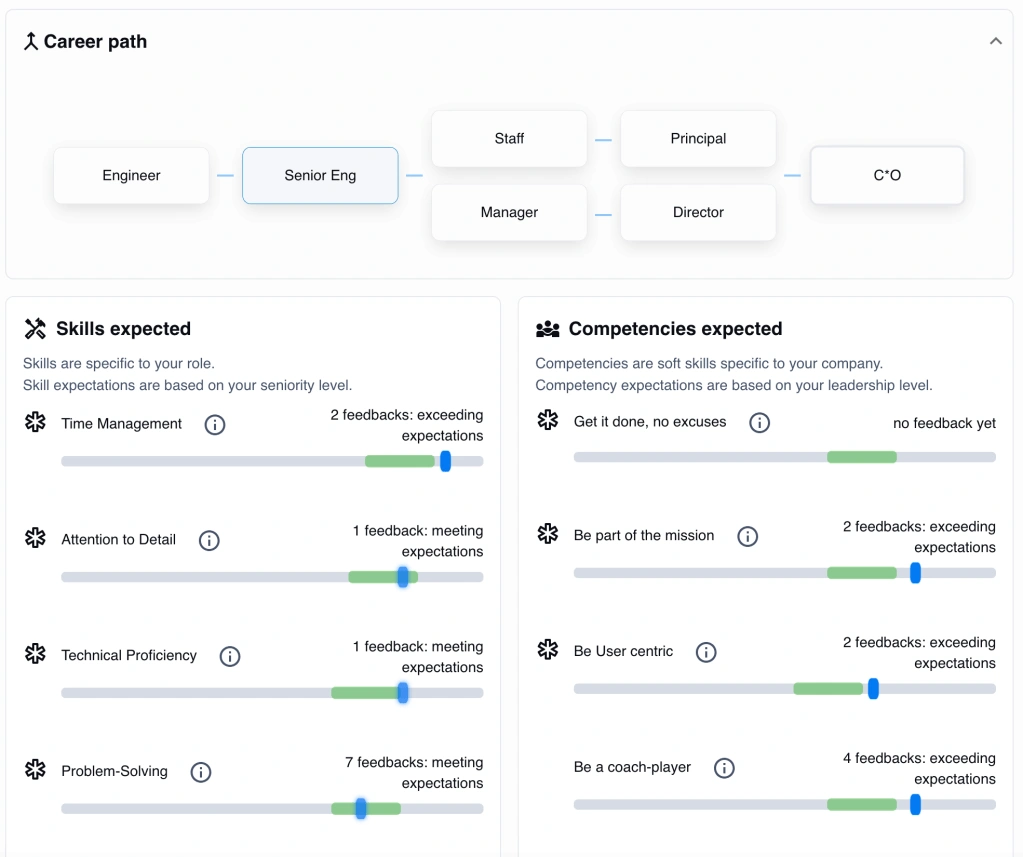
To grow, people need to know what’s expected of them now, and what’s expected of the next level. Enter: the skill matrix or competency map.
A good one defines:
- Core skills: the technical or domain skills needed.
- Behavioral competencies: communication, accountability, leadership traits.
- Level expectations: how those same skills evolve across roles.
Important: do not compare people using a single scale. You may have a similar skill, maybe even a skill with the same name, but you need a different scale when there is a level change. Why:
- Define rating based on behaviours, so you can ask “what do you see” instead of “select the rating from 1 to 5” (or from “not good” to “expect”);
- Ranges are key: folks want to see that there are levels below their current performance, and space for over-achievement. Too easy, or too difficult doesn’t help anyone;
- It’s impossible to rate “universally”: if you ask for feedback, the person providing that feedback has a subconscious “level” filter. If you ask to rate a particular skill for an IC1 and the person is “exceptional”, the meaning is “exceptional at their level”.
Example: Communication Skill Progression (Engineering)
| Level | “Good” Expectation range (much better if supported by the overall scale from “not good” to “really great”) |
| IC1 | Clearly communicates own work and blockers |
| IC2 | Collaborates cross-functionally, shares context in team meetings. |
| IC3 / TL | Proactively communicates trade-offs, aligns stakeholders. |
| Manager | Sets communication norms, diffuses misalignment, supports team messaging. |
🧠 Teams that use clear level expectations in performance conversations report 31% higher perceived fairness and 26% more confidence in promotions.
How Branco Can Help
Branco helps companies define and scale career growth with:
- Role-based paths: See IC, TL, and Manager options side-by-side.
- Custom skill and competency matrices: Define what “good” looks like at every level.
- Growth snapshots: Let employees and managers align on what’s next, with feedback to guide the path.
Because growth only happens when expectations, goals, and feedback align, and Branco was built for that.
TL;DR
- Career paths must reflect parallel growth routes (IC, TL, Manager).
- Help employees make informed, mentored choices, not assumptions.
- Design for what’s real in the next 9–12 months, not what sounds nice.
- Use competency maps to define and communicate expectations clearly.
Clarity is growth fuel. Without it, careers stall and so does your team.
In case you missed it, the series that started it all:
Career Growth Toolkit #1 – Ownership: The Live Promotion Package
Career Growth Toolkit #2 – Know What Good Looks Like: Expectations Made Clear
Career Growth Toolkit #3 – Alignment: Setting Objectives That Actually Work
Career Growth Toolkit #4 – The Plan: Turning Feedback into Actions
Sources and further reading:
- Gartner (2022) – Career Development Statistics
- McKinsey & Company (2022) – The Great Attrition