
Unlocking the Ladder: Why “Levels” Are the Hidden Variable That Shapes Your Career and Your Retirement
I was promoted to VP and never expected that perk to jump 5X!

The Million-Dollar Question You’re Not Asking
Your job title feels important, but what if it’s distracting you from the one variable that quietly dictates your career trajectory and, more importantly, your long-term financial future? We obsess over titles, but companies operate on a hidden framework: levels.
Most professionals don’t know their level, and even fewer ask how it impacts their total compensation over time. This lack of awareness isn’t just a small oversight; it’s a blind spot that can cost you hundreds of thousands, if not millions, of dollars over the course of your career. The difference between one level and the next isn’t just a small pay bump: it’s a compounding engine for your retirement plan. This is what you need to understand.
What Are Levels?
Think of levels as the company’s internal scaffolding—the real structure behind job titles. A title like “Senior Developer” or “Product Manager” is useful shorthand, but the level is the unit that actually calibrates scope, expectations, and reward across the entire organization.
Levels codify the details you usually only discover after joining or getting promoted:
- The expected scope and impact of your work.
- The specific performance expectations for your role.
- The compensation bands for base salary, bonuses, and, most critically for wealth generation: equity.
- Eligibility for perks and other programs.
A “Senior Developer” at Startup A is not the same as a “Senior Developer” at MegaCorp B. As data from Levels.fyi clearly shows, even within the same company, a PM at Level 59 and a PM at Level 62 can have vastly different expectations and compensation packages, often tens of thousands of dollars apart annually.

Why Levels Are Your Financial North Star
Ignoring your company’s leveling system is like navigating a building without knowing the floor numbers. For employees, understanding it is the key to unlocking not just career growth, but significant long-term wealth.
For Employees: From Paycheck to Portfolio
- Financial Planning, Not Just Career Clarity: Levels provide granular steps for promotion. Each step up isn’t just a new title; it’s a predictable jump to a new compensation band. Understanding this allows you to forecast your earning potential and strategically plan your financial future, from saving for a house to maximizing your retirement accounts.
- Sharper Development for Higher Returns: Levels come with concrete expectations of scope and impact. Focusing your development on meeting the criteria for the next level is the most direct way to secure the promotion that unlocks a higher salary and, crucially, a larger grant of equity that will grow over time.
- High-Stakes Negotiation Power: Knowing the market rate for your level, not just your title, gives you immense leverage in negotiations. Securing a higher level upon entry or promotion sets a new, elevated baseline for all future earnings, bonuses, and equity refreshes. This single move can have a compounding effect worth millions over a career.
- Strategic Mobility for Wealth Preservation: A lateral move to a different team or function can feel like a step sideways. But if you understand the leveling system, you can ensure the move is truly parallel, preserving your compensation and equity vesting schedule, protecting your long-term financial plan.
For Employers & HR: The Architecture of Fairness and Retention
- Structured & Equitable Compensation: Levels create consistent, auditable bands for pay, bonuses, and equity, ensuring fairness.
- Parallel Career Paths: They allow individual contributors (ICs) and managers to be rewarded comparably for equivalent impact, which is essential for retaining top technical talent who don’t want to become managers.
- Cross-Functional Alignment: A common language for seniority (“she’s an L5”) aids in staffing, calibration, succession planning, and building balanced teams.
- Improved Internal Mobility & Retention: According to LinkedIn data, visible career frameworks support internal moves, which in turn boosts retention. When employees see a clear path forward, they are less likely to leave.
How Levels Are Used in the Wild
Large employers have embraced job architecture. Research from Mercer finds that over 75% of companies now use a formal career framework to tie compensation, mobility, and talent planning together.
Common patterns include:
- Granular Internal Grades: Multiple numeric or lettered “levels” often exist within the same title (e.g., Software Engineer II, III, and Senior).
- Cross-functional Leveling: A single level (e.g., “Level 6”) maps to similar expectations of impact. These could be used company-wide, or within a group of functions (example: across engineering, product, and design).
- Parallelization: Companies use levels to equate a Principal IC with a Director, ensuring their compensation reflects their comparable impact. This is how you keep your best experts without forcing them into management.
Levels aren’t a perfect system, but they are a pragmatic tool for managing fairness and complexity at scale. They aren’t bureaucratic overhead; they are the scaffolding that makes large-scale opportunity and equity possible.

How Branco Makes the Invisible, Visible
The problem is that this critical information is often opaque.
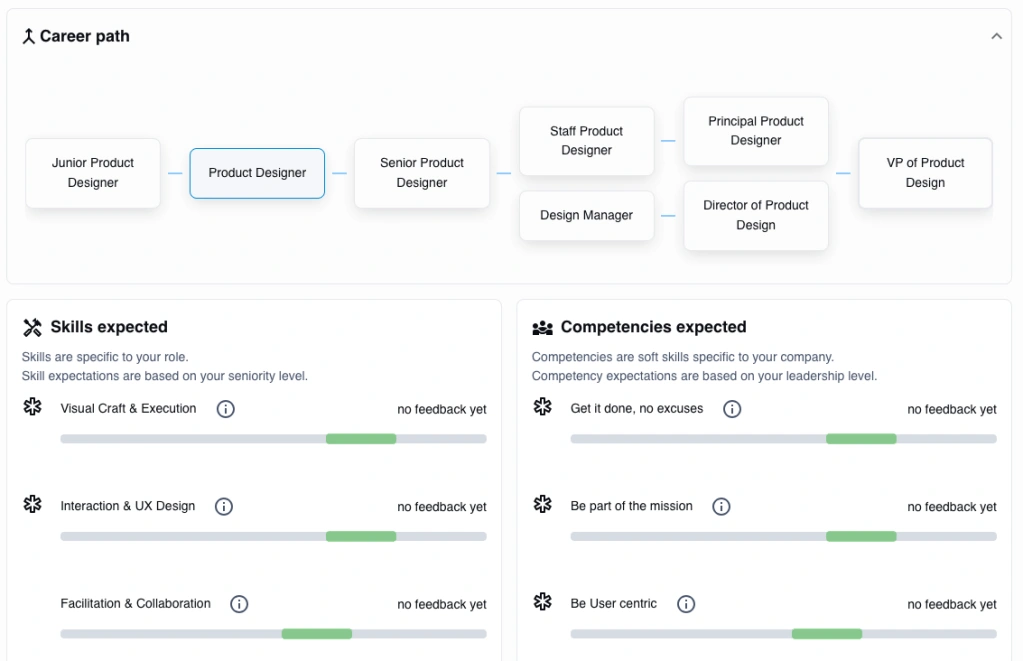
We like showing careers horizontal, like a path, not like a ladder
Branco’s platform is designed to make levels readable, actionable, and tied directly to your growth and financial future.
- Visual Level Mapping: We show you the entire matrix of roles in your organization, so you can see all possible paths: up and sideways.
- Competency Integration: We tie concrete skills and expectations to each level, so you know exactly what to develop to get to the next rung.
- Feedback → Level-Readiness: Our system structures feedback and action plans around the specific competencies required for your next promotion.
- Career & Financial Transparency: We demystify the system, making internal mobility and parallel paths discoverable so you can proactively plan your career and your financial journey, rather than leaving out of frustration or ignorance.
TL;DR
Stop focusing only on your job title. Levels are the hidden variable defining your scope, compensation bands, equity, and the true meaning of seniority. Understanding and navigating them is the single most important thing you can do for your long-term career growth and financial security.
A clear, transparent leveling framework boosts mobility and retention for companies, and for employees, it turns career guesswork into a strategic plan for wealth.
In case you missed it, the series that started it all:
Career Growth Toolkit #1 – Ownership: The Live Promotion Package
Career Growth Toolkit #2 – Know What Good Looks Like: Expectations Made Clear
Career Growth Toolkit #3 – Alignment: Setting Objectives That Actually Work
Career Growth Toolkit #4 – The Plan: Turning Feedback into Actions
Sources and further reading:
- Levels.fyi: For real-world, crowd-sourced data on compensation by level across major companies.
- Mercer: For research on the prevalence and design of job and career architecture frameworks.
- LinkedIn Business Solutions: For data on global talent trends, including the impact of internal mobility on retention.